

For offices and meeting rooms
Office acoustics: clearer calls and meetings
Wall and ceiling sound absorbers, acoustic partitions and desk dividers shorten the reverberation in single offices, team rooms, open-plan offices and meeting rooms. Voices sound clearer, and nobody has to talk over the room.
- Pay by invoice for businesses
- Reply on the next working day
- Free consultation
Glass, smooth walls and desktops reflect speech around the office several times over. The reverberation makes phone calls and meetings tiring, and anyone who wants to be understood speaks louder. Wall absorbers and ceiling elements shorten the reverberation without any building work.
Why is office noise so disruptive?
Employees name noise as the number one source of disturbance in the office, ahead of climate and lighting. Other people's conversations and phone calls are the most disruptive.1 In experiments, speech at levels as low as 35 dB(A) reduced performance on tasks that rely on short-term memory, such as arithmetic or remembering text. On top of this comes the Lombard effect: when background noise is high, everyone speaks louder. When room acoustics measures bring it down, people speak more quietly again.1
What reverberation time applies to offices?
The German workplace rule ASR A3.7 sets upper limits for unoccupied offices: 0.8 seconds in single and two-person offices, 0.6 seconds in multi-person offices.2 It assigns meetings in conference rooms to activity category I, with a rating level of no more than 55 dB(A); general clerical work belongs to category II with 70 dB(A).2 For workrooms with a ceiling height of 2.5 m, DIN 18041 recommends an equivalent sound absorption area of at least 0.25 m² per cubic metre of room volume.3 The VDI 2569 guideline describes how offices are planned acoustically beyond this.4
What helps in which office room?
Single and two-person offices need the least: for rooms up to 20 m², ASR A3.7 assumes an average sound absorption coefficient of 0.15.2 Wall absorbers on the free wall opposite the desk are the simplest solution here. In meeting rooms, ceiling elements above the table work over a large area, because the ceiling is the largest free surface.1 Where several people work, desk dividers absorb sound directly between the workstations. Open-plan spaces have their own page: Acoustics in open-plan offices.
Office noise control: room acoustics or sound insulation?
“Noise control in the office” covers two different tasks. Structural sound insulation stops noise from the neighbouring office, the corridor or the street from getting in; walls, ceilings, doors and windows are responsible for this, as set out in DIN 4109. Room acoustics make sure that sound does not echo back and forth within the room itself; DIN 18041 and ASR A3.7 apply here. In most offices, the noise is created in the room itself: conversations, phone calls, keyboards. In that case, sound absorption helps, not sound insulation. Wall and ceiling sound absorbers, acoustic partitions and desk dividers noticeably lower the noise level, with no building work and no tradespeople.
Noise control in open-plan offices and open spaces
In open-plan offices, three building blocks work together. Ceiling rafts above the desk groups absorb reverberation throughout the room, because the ceiling is the largest free surface. Free-standing acoustic partitions and room dividers divide the space into zones, dampen conversations between teams and provide visual privacy, with no building work required. Desk dividers catch speech directly at the workstation, where it is created. This lowers speech intelligibility at the neighbouring desk and makes focused work possible again. There is more about open spaces on the Acoustics in open-plan offices page.
Which sound absorbers suit offices?
- Fiber, made of PET felt, reaches absorption class A (αw 0.9) at 50 mm and is classified B-s1,d0 under EN 13501-1. The practical choice for offices, meeting rooms and call centres.
- Hybrid with Basotect achieves αw 0.95 in the 70 mm element, giving a strong effect on a small area.
- Velvet, with its velvety surface and wide choice of colours, suits reception areas and lounges, but is combustible (class F) and not intended for rooms with fire safety requirements.
- Acoustic art panels with a logo or imagery combine room acoustics and corporate design, for example behind the video call desk.
All wall absorbers are bonded, with no drilling. You'll find an overview under Sound absorbers for walls.
Sources (in German)
- DGUV: DGUV Information 215-443 Akustik im Büro, March 2021, sections 2, 3.6, 4 and 8.1
- Ausschuss für Arbeitsstätten: ASR A3.7 Lärm, March 2021 edition, sections 3.16, 5.1, 5.2.1 and Annex 2, Table 3
- Nocke, Burkart: Überarbeitung der DIN 18041, DAGA 2015, Table 2
- VDI: VDI 2569 Schallschutz und akustische Gestaltung in Büros, October 2019
How we work
Planned, calculated, measured again
- Target value by standard
- The target reverberation time comes from DIN 18041 and depends on how the room is used — a nursery group room needs a different value than an open-plan office.
- Measured, not estimated
- We measure reverberation time T20 in line with DIN EN ISO 3382, before planning and after installation.
- Verification
- In the projects we have published so far, the final measurement was less than 3 % off the simulated value.
Solutions by room
Every room sounds different

Workstation with Velvet Hexa Light
Where people phone and think
Single and two-person office
In a small office, it is mainly your own voice that echoes. Wall absorbers on the free wall opposite the desk shorten the reverberation without taking up space. ASR A3.7 sets a maximum of 0.8 seconds for single and two-person offices.
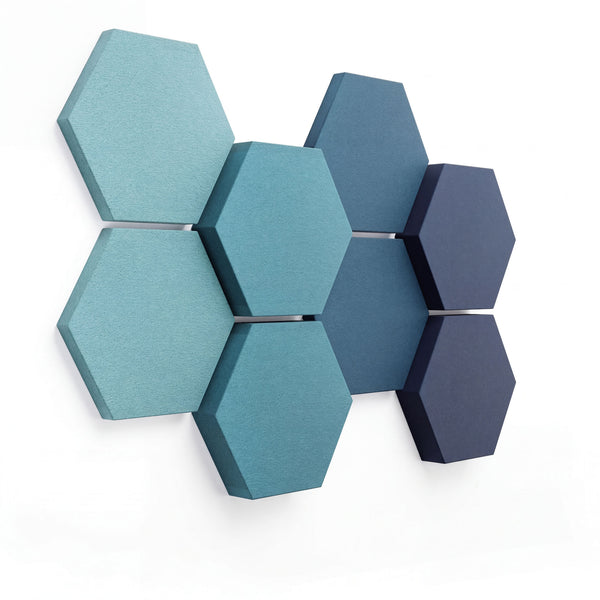
- Fiber Hexa made of PET felt, bonded
- Velvet Hexa Light for more colour
- Guide value under ASR A3.7: max. 0.8 s

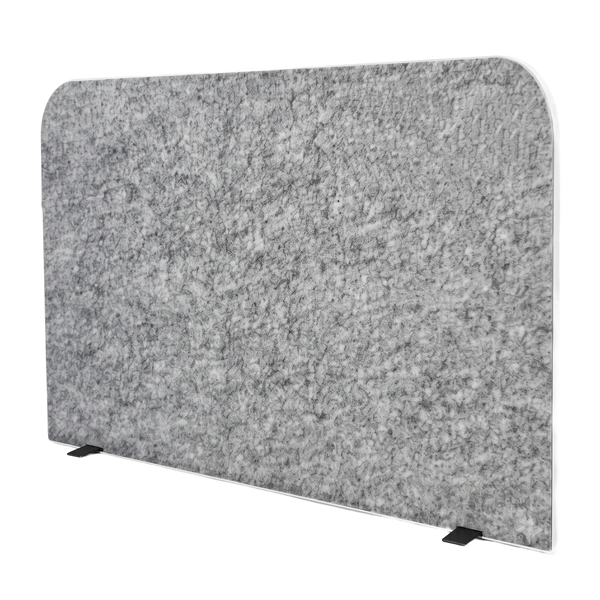
Desk Divider Slim, product photo
Where several conversations run at once
Multi-person office
When several people work in one room, it is mainly other people's conversations that disturb. Desk dividers between facing workstations absorb sound right at the desk, and ceiling elements reduce the reverberation throughout the room. ASR A3.7 sets a maximum of 0.6 seconds here.
- Desk Divider Slim, 1200 × 600 mm, clamp-on
- Fiber Sky above the desk groups
- Guide value under ASR A3.7: max. 0.6 s

Meeting room with Velvet Hexa Shades
Where everyone needs to understand each other
Meeting room
ASR A3.7 counts meetings as highly concentrated work, so the rating level must not exceed 55 dB(A). Ceiling elements above the table work over a large area, and wall absorbers on the end wall complement them.
- Fiber Sky above the table, suspended
- Velvet Hexa Shades on the wall
Where the microphone is listening
Video call desk
In a video call, what counts is how well you are understood. An acoustic art panel with your own design behind the desk absorbs sound and doubles as your on-screen background. Wall absorbers on the opposite wall complement it.
- Pix Canva acoustic art panel with your own design, 50 mm
- Fiber Hexa on the opposite wall

Office meeting area with Ruhesäule Quadra
Where visitors arrive
Reception and waiting area
Reception areas often combine glass, stone and conversations at the desk. Ceiling elements absorb the sound above the desk. An acoustic column on a metal stand adds absorption in the waiting area, with no drilling required.
- Ruhesäule Quadra, 2000 × 340 × 340 mm, fabric of your choice
- Fiber Sky above the reception desk
Ready to order
Absorbers and desk dividers for offices

Example fit-out
What does a room need?
A first estimate based on our rule of thumb. We calculate the quote with your room data.
Your estimate
- Absorber area
- –
- of which wall, approx. 70 %
- – · Fiber Hexa (Set of 8 / Set of 10)
- of which ceiling, approx. 30 %
- – · Fiber Sky Deckenelemente
- Indicative material price
-
– net
– gross
Estimate without installation and shipping, based on current shop prices. Depending on room height, use and requirements, the need can be considerably higher.
How B2B projects start
Review the data before preparing a useful quote
Not every project needs an on-site appointment. Photos, dimensions and a short description are usually enough for a reliable first step.
- 01
Show the room
Send photos, a floor plan or plan link plus the room use and approximate dimensions.
- 02
Clarify requirements
We review questions, suitable product families and whether a measurement or site visit makes sense.
- 03
Receive a quote
You receive a clear quote with the available documents for your internal approval.
Frequently asked questions
What reverberation time should an office have?
For unoccupied offices, the German workplace rule ASR A3.7 sets a maximum of 0.8 seconds in single and two-person offices and 0.6 seconds in multi-person and open-plan offices, in each case in the octave bands from 250 to 2,000 Hz.
How many absorbers do I need for my office?
For workrooms with a ceiling height of 2.5 m, DIN 18041 recommends at least 0.25 m² of equivalent sound absorption area per cubic metre. An office with a floor area of 20 m² has a volume of 50 m³, which corresponds to 12.5 m². Furniture, flooring and existing surfaces count towards this. The example set-up on this page gives you a first guide value; we calculate the exact requirement using your room data.
How loud can it be in an office?
ASR A3.7 distinguishes by activity: for highly concentrated work, such as meetings or software development, the rating level must not exceed 55 dB(A); for general clerical work, 70 dB(A). For background noise in a two-person office, it recommends a maximum of 40 dB(A).
What helps if the meeting room echoes?
The ceiling makes the biggest difference because it is the largest free surface. Ceiling elements such as Fiber Sky hang above the table, and wall absorbers on the end or back wall complement them. According to the DGUV, speech intelligibility in meeting rooms is often too low, and less reverberation improves it.
Does this also help against noise from neighbouring rooms?
No, and that is an important difference: sound absorbers improve the acoustics within the room by reducing reverberation. Sound transmitted through walls, ceilings or doors requires structural sound insulation. If you are unsure what will solve your problem, ask us before you order.
How are the elements mounted?
Fiber Hexa is bonded — the adhesive tape comes with the set. Fiber Sky is suspended on a steel cable system up to 1.00 m below the ceiling. The Desk Divider Slim clamps onto the desk with metal brackets, no tools required. We put together the suspension kits and brackets for you in the quote.
Are the absorbers flame-retardant?
PET elements from the Fiber Line are classified B-s1,d0 under EN 13501-1, tested free-hanging. We will send you the test report on request. We clarify which version your project needs before we send a quote. Find out more on the Acoustic panels and fire safety page.
How quickly will the goods arrive?
Fiber Hexa and Velvet Hexa Shades are in stock and usually ship within 2 to 4 working days. We make Fiber Sky and the Desk Dividers to order, with a delivery time of about four to five weeks.
What helps against noise in the office?
Wall and ceiling sound absorbers work fastest: they reduce the reverberation, and the noise level across the whole room drops. Between workstations, desk dividers and free-standing acoustic partitions dampen other people's conversations. Quiet zones for phone calls help too. You don't need any building work for this.
What can I do if colleagues are too loud in the office?
It is often less about your colleagues than about the room: when it echoes, everyone speaks louder to be understood. With less reverberation, conversations get quieter too. A desk divider between facing workstations and a set place for phone calls bring additional calm.
Do partitions help against office noise?
Yes, against conversations and phone calls nearby. Free-standing acoustic partitions absorb sound on both sides and provide visual privacy. However, they do not reach the ceiling and do not replace a solid wall when conversations need to stay confidential.
Which regulations apply to noise control in the office?
The German workplace rule ASR A3.7 sets maximum values for reverberation time and noise at the workplace. DIN 18041 gives recommendations for the sound-absorbing area, and the VDI 2569 guideline describes the acoustic design of offices. DIN 4109 applies to structural sound insulation between rooms.
How much do office acoustics cost?
That depends on the room size, product and quantity. The example set-up on this page shows a guide price excluding and including VAT. Businesses can pay by invoice; we calculate the quote after a free initial assessment.
Project consultation
We review your project
Send us the use, approximate room dimensions, photos or plans. We will respond with questions and a suitable next step.
- Purchase on account for businesses and institutions – via a personal quote
- Quote and available product documents for internal approval
- Initial advice usually based on photos, plans and room data
Request a free assessment
Name, email and a short description are enough. You can add photos or plans as a link.