


Measured case study · School
Room 33
A classroom at the Auenschule Schweinfurt: the surfaces, the measurements and the questions behind an acoustic treatment.
- Before
- 1.31 s
- After
- 0.67 s
- Reduction
- −49 %

For schools & school authorities
Ceiling elements and wall absorbers shorten the reverberation in the classroom. Pupils understand teachers and classmates better, and nobody has to talk over the room.
In many classrooms, hard ceilings, walls and windows reflect sound for a long time. Anyone talking over this reverberation gets louder, and the class follows suit. Ceiling elements and wall absorbers shorten the reverberation, make speech easier to understand throughout the room and create a calm learning atmosphere.
According to Unfallkasse NRW, the average sound level during lessons is 60 to 70 dB(A), and 70 to 75 dB(A) in primary schools.6 Levels like these rarely endanger hearing, but they do get in the way of communication. If teachers have to make themselves heard over the noise, the DGUV says their voice and larynx are put under excessive strain.4
According to the DGUV, classrooms of a typical size should have a reverberation time of 0.5 to 0.6 seconds.1 The German workplace rule ASR A3.7 sets an upper limit for teaching rooms, Ttarget = (0.32 · lg V − 0.17) s. For an occupied room of 210 m³, that is about 0.6 seconds.2 If pupils with impaired hearing take part or lessons are taught in a foreign language, it should be 0.4 to 0.5 seconds.1 For this, DIN 18041 specifies the inclusive usage type A4 with Ttarget = (0.26 · lg V − 0.14) s.3
In a field study with 487 primary school children from 21 classes (reverberation times of 0.49 to 1.1 seconds), children in reverberant rooms did worse at understanding speech and remembering spoken content. They also rated their relationships with classmates and teachers less positively.5 The DGUV reports level differences of up to 13 dB between acoustically good and poor classrooms, and significantly fewer signs of stress among teachers.4
“Noise control in schools” covers two different tasks. Structural sound insulation keeps out noise from neighbouring rooms, the corridor or the street: airborne sound through walls and doors, impact sound through floors and ceilings. The benchmark for this is DIN 4109 “Sound insulation in buildings”; walls, ceilings, doors and windows are responsible for it — and therefore the school authority, in new builds or refurbishments. Room acoustics make sure that sound does not reverberate for long within the classroom itself. The benchmark here is acoustic quality under DIN 18041 “Acoustic quality in rooms”.
Much of the noise in a classroom is created in the room itself: conversations, chairs scraping, footsteps, the teacher's voice. In a reverberant room, this background noise mixes with speech and the noise level keeps building up. Sound absorption on the ceiling and walls helps against this — with no building work, and it can be retrofitted while lessons continue. Sound absorbers do little against sound from the room next door, however. If you need sound insulation between classrooms, structural improvements are required.
In the canteen, lots of pupils, crockery and hard surfaces come together. Without sound-absorbing surfaces, the noise level rises by the minute, because everyone speaks louder to be understood. Ceiling absorbers above the tables shorten the reverberation and turn the break back into a break.
A music room needs different acoustics from a classroom. DIN 18041 lists music as its own usage type, A1, with a longer target reverberation time than teaching (A3). If a music room is over-damped, instruments and choirs sound dull. That is why we don't plan music rooms by rule of thumb, but with the actual room data. If the main aim is that neighbouring classes don't hear anything, sound insulation under DIN 4109 is needed as well.
The ceiling is the first choice: the DGUV names a sound-absorbing ceiling area as the way to reach the target values.1 Suspended ceiling panels can be retrofitted without building work. In teacher-led lessons, wall absorbers on part of the back wall can improve intelligibility for the front rows.4 Corridors, stairwells, break halls and assembly halls should also be designed with room acoustics in mind.7 We check reaction to fire, mounting method and the requirements of your federal state before we send a quote — find out more under Acoustic panels and fire safety.
Completed rooms
Measured projects are documented in detail. Approved customer images also show typical everyday applications.
Measured case study · School
A classroom at the Auenschule Schweinfurt: the surfaces, the measurements and the questions behind an acoustic treatment.
Solutions by room

Visualisation · classroom with wall absorbers
Where lessons happen
In the classroom, the ceiling makes the biggest difference because it is the largest free surface. Suspended ceiling elements above the rows of seats shorten the reverberation throughout the room. In teacher-led lessons, wall absorbers on the back wall stop sound from the back of the room bouncing back to the board.
Where hearing well matters most
For pupils with impaired hearing, language support or foreign language lessons, the DGUV cites shorter reverberation times of 0.4 to 0.5 seconds. This needs more absorber area than a normal classroom, usually on both the ceiling and the walls.

Visualisation · stairwell with ceiling elements
Where break-time noise builds up
Long corridors and open stairwells carry break-time noise into the classrooms. The DGUV recommends limiting the reverberation here with sound absorbers too. Because corridors and stairwells are often escape routes, we clarify fire safety and fixings before we send a quote.
Where everyone talks at once
Lots of voices, hard tables, clattering crockery: the canteen is often at its loudest at lunchtime. Ceiling elements above the table groups absorb the sound where it is created, and wall absorbers on free walls complement them.
Where balls fly
In sports halls, the DGUV requires measures against noise, such as sound-absorbing dividing curtains and absorbers in the ceiling area. Where balls hit, wall elements must be ball-impact resistant. We therefore only plan sports halls as projects on request.
Ready to order
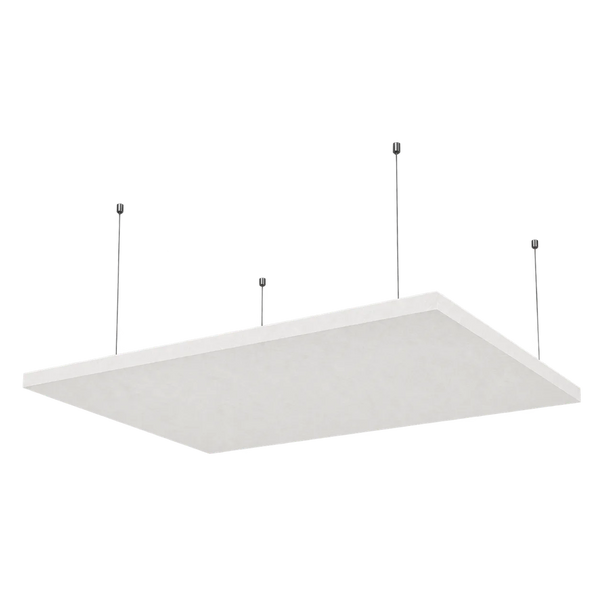


Example fit-out
A first estimate based on our rule of thumb. We calculate the quote with your room data.
Estimate without installation and shipping, based on current shop prices. Depending on room height, use and requirements, the need can be considerably higher.
How B2B projects start
Not every project needs an on-site appointment. Photos, dimensions and a short description are usually enough for a reliable first step.
Send photos, a floor plan or plan link plus the room use and approximate dimensions.
We review questions, suitable product families and whether a measurement or site visit makes sense.
You receive a clear quote with the available documents for your internal approval.
A sound-absorbing ceiling is the most effective measure: it shortens the reverberation time, the class speaks more quietly and the noise level drops. Felt pads against scraping chairs and wall absorbers on the back wall help too. Against noise from neighbouring rooms, however, only structural sound insulation helps.
According to the DGUV, 0.5 to 0.6 seconds for classrooms of a typical size. The German workplace rule ASR A3.7 uses Ttarget = (0.32 · lg V − 0.17) s; for an occupied room of 210 m³, that is about 0.6 seconds.
If pupils with impaired hearing take part or lessons are taught in a foreign language, the DGUV cites 0.4 to 0.5 seconds. DIN 18041 provides usage type A4 for this, Ttarget = (0.26 · lg V − 0.14) s. For 200 m³, that gives around 0.45 seconds.
The German workplace rule ASR A3.7 explicitly names schools: in occupied teaching rooms, the reverberation time must not exceed the value from its formula. The DGUV rule for schools refers to the same target values. Classrooms are teachers' workplaces.
The DGUV names a ceiling with an overall sound absorption coefficient of 0.5 to 0.6 as a way to reach the target values. How much area that means with our elements depends on the room volume, furnishings and product. The example set-up on this page gives you a first guide value; we calculate the exact requirement using your room data.
Yes. In a field study with 487 primary school children, children in reverberant classrooms understood speech less well and remembered spoken content less well. The DGUV reports level differences of up to 13 dB between acoustically good and poor rooms, and less stress among teachers.
No, and that is an important difference: sound absorbers improve the acoustics within the room by reducing echo and reverberation. Sound transmitted through walls, ceilings or windows requires structural sound insulation. If you are unsure what will solve your problem, ask us before you order.
That depends on the state building regulations, your federal state's school building requirements and the type of room; corridors and stairwells are assessed separately. Reaction to fire is classified for each product under EN 13501-1 — our 50 mm PET felt, for example, as B-s1,d0 in a free-hanging installation. We will send you the test report for the product in question on request. Find out more under Acoustic panels and fire safety.
Yes. Ceiling elements are suspended on steel cables and wall elements are bonded, so no building work is needed. Ceiling elements are made to order and have a delivery time of about 4 weeks, so plan your order before the holidays.
That depends on the room size, product and quantity. The example set-up on this page shows a guide price excluding and including VAT. We calculate the quote after a free initial assessment.
Yes. For schools, school authorities and institutions, pay by invoice works via a personal quote. You can request samples and tender specification texts using the form.
Project consultation
Send us the use, approximate room dimensions, photos or plans. We will respond with questions and a suitable next step.
Name, email and a short description are enough. You can add photos or plans as a link.